Journal · Stone guides
Obsidian: The Rift Valley's Volcanic Glass
What obsidian is, why it is so glossy and sharp, how people in Kenya's Rift Valley used it for a million years, and the difference between mahogany and snowflake obsidian.
Hold a polished obsidian bead up to the light and it shines like a dark mirror. Run a thumb over it and it feels cool and perfectly smooth, like a glass marble.
That is because it is glass. Not glass from a factory, but glass made by a volcano.
In Kenya, you do not have to go far to find where it comes from. The stretch of the Rift Valley between Naivasha and Nakuru is full of it, and people here have been picking it up and using it for a very long time.
What is obsidian?
Obsidian is natural volcanic glass. It starts as a thick, sticky lava, rich in silica, the same ingredient that sand and window glass are made of. In obsidian, silica usually makes up 70% or more of the rock.
Lava like this is so stiff that its atoms struggle to move around and line up into crystals. If it also cools quickly, they never get the chance. The rock sets hard in a jumble, with no crystal pattern at all. That jumble is what we call glass.
So obsidian is a stone, but an unusual one. Most stones are made of crystals. Obsidian is made of frozen liquid.
Why obsidian is so glossy and so sharp
Because there are no crystals inside, light meets one smooth, unbroken surface. Freshly broken obsidian already shines, and polishing it brings out an even deeper gloss. That is the look you see on an obsidian bracelet.
The same lack of crystals explains its edge. When obsidian breaks, it splits in smooth, curved shells, the way thick glass does. Those curves meet in very fine edges. The cutting edge of an obsidian blade can be only about three nanometres thick, and surgeons have tried obsidian scalpels for that reason.
There is a catch. Obsidian sits around 5 to 6 on the Mohs hardness scale, softer than quartz, so harder stones can scratch it. It is also brittle. It does not bend; it chips. Keep that in mind for later.
Obsidian in Kenya: a million years of use
Archaeologists describe the Naivasha–Nakuru basin as one of the world's most obsidian-rich landscapes. People noticed long ago.
At Kariandusi, on the shore of Lake Elmenteita, early humans made hand axes, and obsidian was the main stone they used. The site is roughly 700,000 years to a million years old.
Much later, foragers living at Gamble's Cave, a site Louis Leakey dug in the Central Rift, kept choosing high-quality obsidian from Mount Eburru, about 20 km away, even when other stone was closer to hand.
Then came the herders. The Elmenteitan people, who kept livestock in the region from about 3,200 to 1,500 years ago, had plenty of stone to choose from: chert, quartz, basalt. They still preferred one source above all: a green-tinged obsidian from a quarry high on the slopes of Mount Eburru. Small groups climbed the mountain, camped near the quarry and prepared the stone for the journey home. It was then passed along to family groups spread far across the region. Obsidian from the Eburru area turns up at Ngamuriak, a herders' settlement well away from the mountain.
How do archaeologists know where a blade came from? Each obsidian flow has its own chemical fingerprint. A handheld X-ray scanner can read it from a tool and match it to a source.
Hell's Gate and Ol Njorowa
Close to Lake Naivasha lies Hell's Gate National Park. Its main gorge, Ol Njorowa, cuts between red cliffs, with volcanic plugs like Fischer's Tower standing alone on the valley floor. The explorers Gustav Fischer and Joseph Thomson gave the place its English name in 1883.
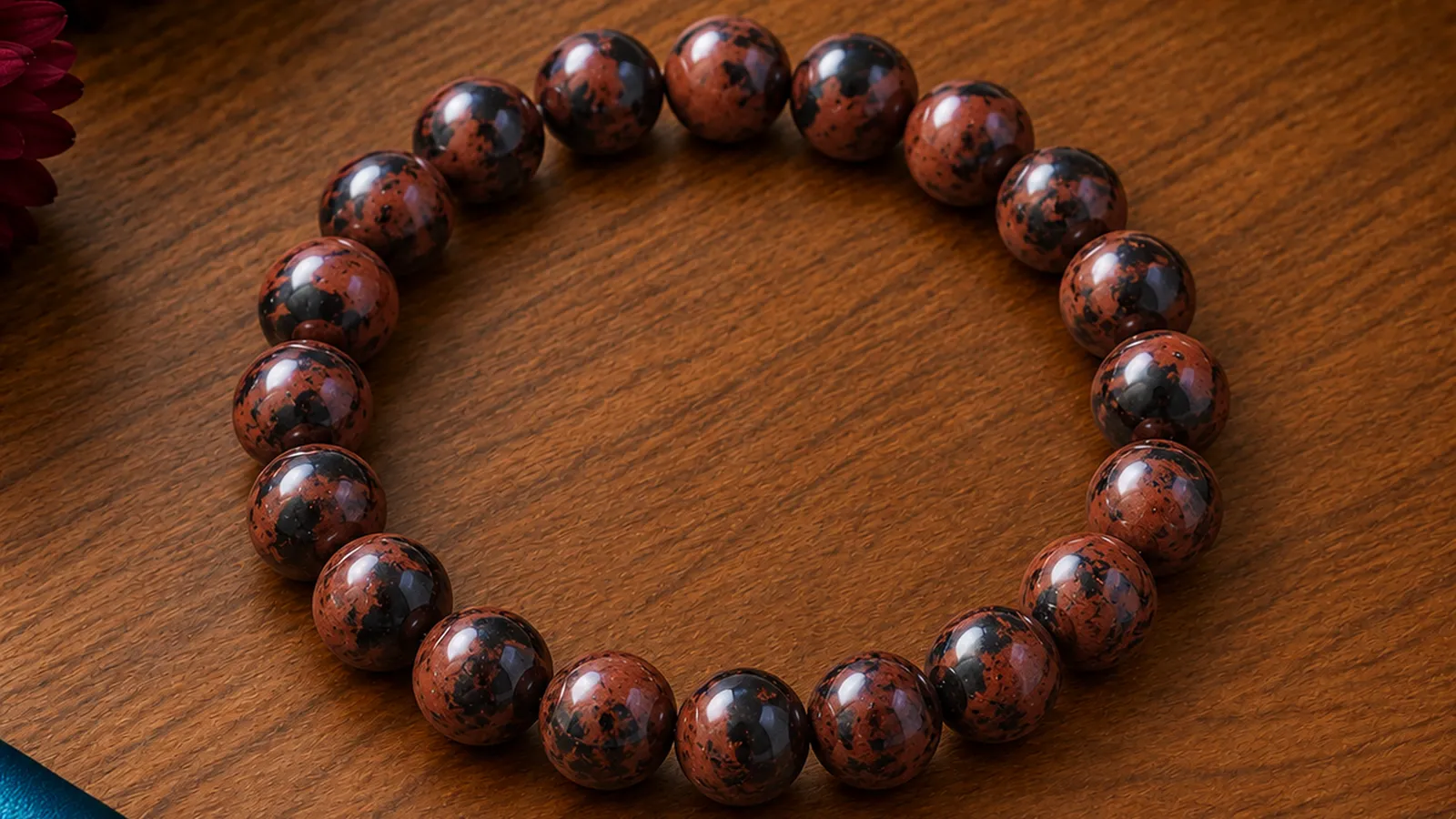
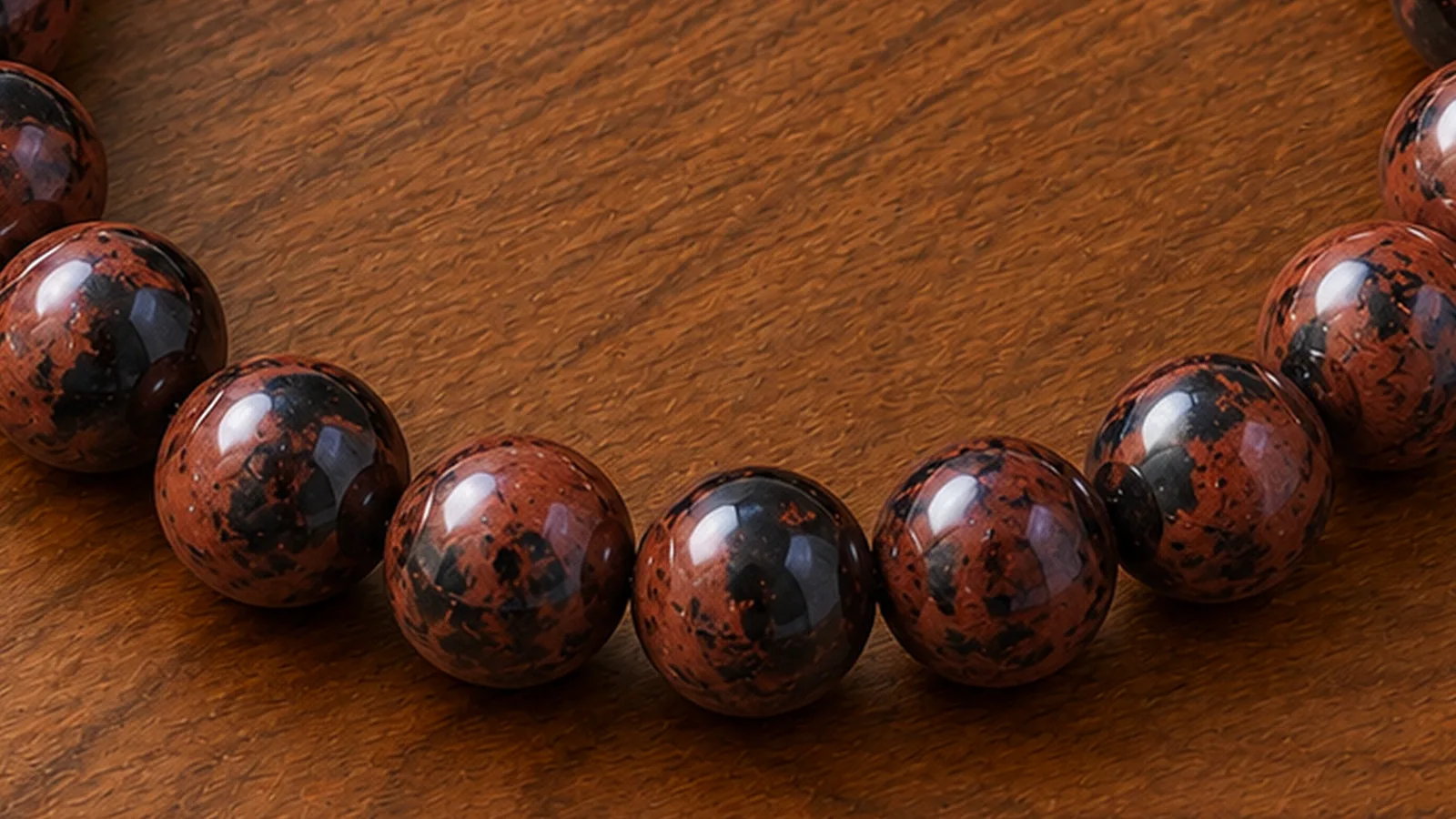
Our Njorowa Ember takes its name from that gorge. It is mahogany obsidian, polished to a gloss, with red-brown and black in soft patches, roughly half and half. The name is a tribute to the place; we are not saying the beads were dug there.
Mahogany obsidian: black glass with a warm glow
Most obsidian is black. Iron and other metals in the glass give it that dark colour. Mahogany obsidian is the black-and-brown kind. Its red-brown streaks and patches are put down to iron as well, in the form of tiny specks of iron oxide such as hematite. Where they gather, the glass turns the colour of polished wood. Where they do not, it stays black.
No two beads mix the colours the same way, so no two mahogany bracelets look exactly alike.
The Kahawa Ember (kahawa is Swahili for coffee) leans warmer: red-brown beads marked with natural black patches, like dark-roast beans.
Snowflake obsidian: when glass starts to crystallise
Glass is not completely stable. Over a very long time, some obsidian begins to form crystals after all. A white or grey mineral called cristobalite grows in small, rounded clusters inside the black glass. Cut and polish the stone, and those clusters look like snowflakes on a night sky. That is snowflake obsidian.
The Nelion Snow carries the name of Nelion, the second-highest peak of Mount Kenya at 5,188 metres. Round black beads, scattered with grey-white spots, calm and striking at the same time.
Round beads or chips?
Snowflake obsidian also comes as chips: small, uneven pieces that keep a rawer, more natural shape. They catch the light from many angles at once.
The Kinangop Frost is our chip bracelet, named after the high Kinangop plateau, about 2,400 metres up at its edge, known for its chilly nights. It is light, easy to stack, and a gentle way to start with obsidian.
If one stone is not enough, you can build your own. Obsidian sits well beside the matte texture of lava stone (we wrote about lava in Lava Stone: The Volcano on Your Wrist), and its gloss sets off golden or white stones too. Start from Njorowa Ember, add a second stone and see it come together.
How to care for an obsidian bracelet
Remember: it is glass. Treat it the way you would treat a good watch face.
- Avoid knocks. Take it off for the gym, football and heavy lifting. A hard hit against a desk or doorframe can chip a bead.
- Store it on its own. Keep it in a soft pouch or a separate spot, away from harder stones that could scratch it.
- Keep it dry. Take it off before swimming or showering, and put perfume and lotion on before the bracelet, not after. This protects the stretch cord as much as the stone.
- Clean it simply. A soft, dry cloth brings the shine straight back.
What obsidian is said to mean
Obsidian is traditionally associated with protection. Mahogany obsidian is often linked with strength and steadiness, and snowflake obsidian with clarity and balance. These are beliefs passed down in crystal lore, not proven effects. Many people simply like the idea of wearing a stone born in a volcano.
Either way, the next time you drive along the Rift Valley floor past Naivasha, look at the dark rock by the road. Some of it is glass, and people here knew what to do with it long before anyone made a bracelet.
Still deciding? Find your bracelet in a few questions, or try one on at ManCave.